Autore / Author: Adriana Pignatelli Mangoni
Anno / Year: 2023 (digital image capturing)
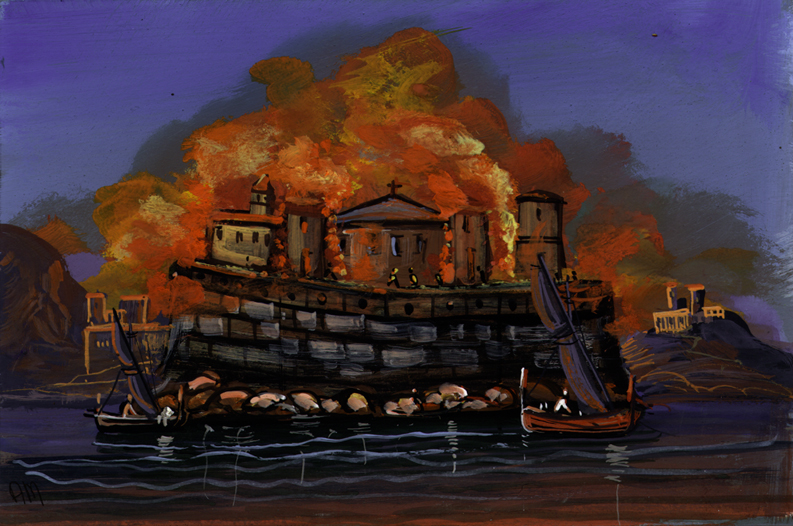
Soggetto / Subject: Incendio della città di Lipari del 1554 / Fire of the city of Lipari in 1554
Descrizione / Description: Nel 1544 la città di Lipari fu assalita dalla flotta ottomana guidata da Ariadeno Barbarossa. L’attacco portò alla devastazione del centro abitato e alla deportazione in schiavitù di migliaia di abitanti. Il notaio Andrìa de Simòn ne lasciò una dettagliata testimonianza, che consente ancora oggi di comprendere la portata dell’evento. Il sacco segnò un trauma profondo per la comunità eoliana, che per decenni faticò a riprendersi sul piano sociale ed economico. Nel Settecento, viaggiatori del Grand Tour visitarono Lipari trovandovi tracce di questa ferita storica: tra le rovine e le fortificazioni ricostruite, leggevano i segni delle tensioni tra Europa e mondo ottomano, in un contesto dove il paesaggio mediterraneo diventava anche archivio visibile di memorie conflittuali / In 1544, the town of Lipari was attacked by the Ottoman fleet led by Hayreddin Barbarossa. The assault resulted in the devastation of the settlement and the enslavement of thousands of inhabitants. The notary Andrìa de Simòn left a detailed account of the event, which still allows us to grasp its scale. The sack left a deep trauma on the Aeolian community, which struggled for decades to recover socially and economically. In the 18th century, Grand Tour travellers visited Lipari and found traces of this historical wound: among the ruins and rebuilt fortifications, they read signs of the tensions between Europe and the Ottoman world, in a context where the Mediterranean landscape also served as a visible archive of conflicting memories.
Serie / Series: Adriana Pignatelli Mangoni da Andrìa De Simon
Formato / Format: JPEG; 793 x 526 px; 200 DPI; 24 bit; CMYK
Tecnica / Technique: Gouache
Coordinate / Coordinates: 38.4648988, 14.9838379
Diritti / Rights: CC BY-NC-ND 4.0
Pubblicato da Centro Museale delle Scienze Agrarie – MUSA Università di Napoli Federico II, su concessione di Adriana Pignatelli Mangoni